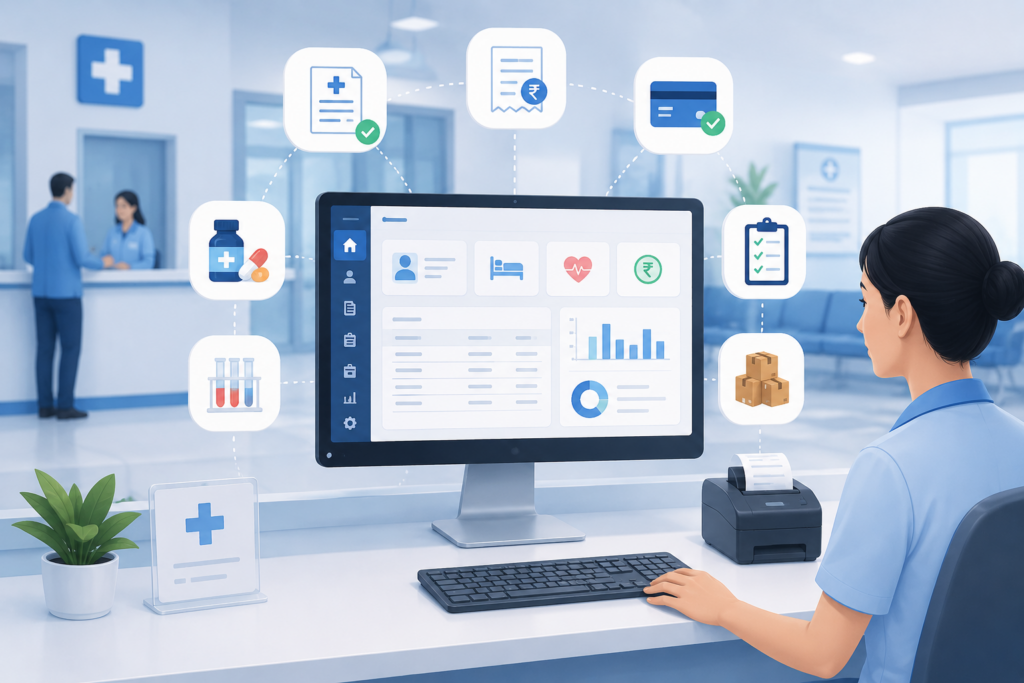
Hospitals possess one of the most complex accounts receivable structures, with payments from multiple entities – patients, private insurers, government programs and charitable organizations all making payments towards hospital bills. With integrated billing solutions in place to automate financial tracking and prevent revenue leakage – and to maximize hospital profitability – payments come flowing in efficiently to keep operations running smoothly and ensure maximum profit potential.
Modern patient billing software systems integrate insurance eligibility verification, automated claims preparation & submission, medical coding capabilities, denial management tools and reporting dashboards into one user-friendly package. OSP offers tailored hospital billing systems designed to fit seamlessly with organizational workflows and operational goals.
Automated data recording
At any healthcare clinic, there are multiple pieces of data that need to be recorded and kept track of, from prescriptions to laboratory tests. Some records may also need to be submitted for regulatory reporting purposes or submitted directly to insurance providers – this requires accurate, timely information that should not be delayed; using hospital finance management software can streamline this process and minimize errors.
OSP provides revenue cycle management (RCM) platforms designed to integrate clinical and billing processes in order to reduce errors, denials and accounts receivable turnaround time while using automation tools for reduced data entry as well as providing reporting dashboards for better cost management of healthcare operations.
An effective PatientERP Hospital Billing Software system should offer a variety of features, such as eligibility verification, automated claims preparation and submission, medical coding capabilities, denial management tools and unified interfaces that consolidate multiple processes; advanced analytics; seamless EHR integration; strong compliance frameworks.
Integrating payment processing with leading accounting tools, like Xero, can streamline payment processing for staff by eliminating manual export of data. Furthermore, this solution ensures invoices reach the intended parties while reflecting accurate tax details; tracking vendor contracts allows it to ensure invoices adhere strictly to pre-negotiated pricing tiers.
Automated insurance claims processing
Medical claims management can be an onerous task that takes days and is fraught with errors, which could delay patient reimbursements by several months or more. Medical claims management systems offer solutions to streamline this workflow and guarantee accuracy from data entry through reimbursements.
Hospital Billing Software automates the tasks of verifying insurance information, filing claims and posting payments accurately. These systems are tailored to work with different payers and can be configured specifically for your practice’s unique requirements – supporting multispecialty workflows and integrated clinical processes as well as multispecialty workflows and processes.
Software like this one can also detect fraudulent activity and suspicious claim patterns using machine learning algorithms to analyze policy details, coverage limits and historical data to detect anomalies that indicate potential fraud indicators – helping reduce healthcare delivery costs while improving profitability at medical facilities.
PatientERP advanced Hospital Management System Software enhances healthcare services by decreasing paperwork, increasing transparency, and improving communication and efficiency. It includes modules for patient registration, appointment scheduling, electronic medical records (EMRs), invoicing/billing for pharmacy management (PM), laboratory monitoring (LM), staff and inventory. As a digital solution it offers unique patient ID generation as well as automated registration, faster check-in, improved decision-making ability and streamlined operations to small hospitals as well as large ones.
Automated revenue cycle management
Healthcare revenue cycles are an integral component of patient satisfaction and financial sustainability, requiring accurate coding, submission of claims on time, timely follow up of claims submission, timely follow-up with payers to ensure payment of medical bills by insurance. But managing this process manually can be costly and time consuming – thus many healthcare organizations are turning to automated revenue cycle management (RCM) software systems which automate data recording, confirm insurance information and create invoicing statements for patients as well as track payments statuses/denials – automating these processes can improve cash flow while decreasing billing errors by automating these processes reducing billing errors while improving cash flow by improving cash flow management/reducing billing errors by automating revenue cycle management processes
An optimal hospital billing system should align with organizational workflows and operational needs, providing features like unified interfaces to consolidate multiple processes, advanced analytics, seamless EHR integration and strong compliance frameworks that enable staff to focus on high-value work and make better decisions.
RCM automation tools can assist in the prevention of claim rejections by reviewing clinical documentation for inconsistencies and verifying procedure codes are accurate, helping ensure claims are submitted with correct codes to avoid rework or delayed reimbursements. Furthermore, these technologies can analyze trends in claim denials to identify causes and implement improvements for future claim submissions without needing additional rework or delays in reimbursements.
A top hospital billing system should be user-friendly and facilitate a positive customer experience, including offering easy-to-read invoices and online payment options. Furthermore, HIPAA regulations must be upheld while confidential data should remain protected with encryption technology, role-based access controls, audit logs, and secure backups being key features of an effective hospital billing solution.
Automated patient billing
Automated patient payment solutions streamline healthcare claims management operations by automating data recording, verifying insurance information and processing claims electronically. They can also generate invoicing statements, maintain payment reunification and track claim history – saving time for human intervention while decreasing administrative costs and speeding cash flow.
Manual medical bills can be an unnerving experience for patients, leading them to delay payments and eventually hurt your revenue. Furthermore, inefficient payment processes may increase accounts receivable while increasing staff workload. To combat these issues and ensure every consultation is accurately billed and invoiced on time a hospital financial management software that integrates clinical and billing workflows is essential. To do so successfully.
When selecting patient payment software, look for solutions with multiple payment options – mobile apps, patient portals, text-to-pay – which reduce payment friction and improve customer satisfaction. Furthermore, these systems should automatically post payments to patient accounts in real time before reconciling them instantly if required. Finally, choose one which complies with industry standards such as HIPAA or PCI while including encryption protocols, role-based access controls and secure backup systems to safeguard patient accounts.