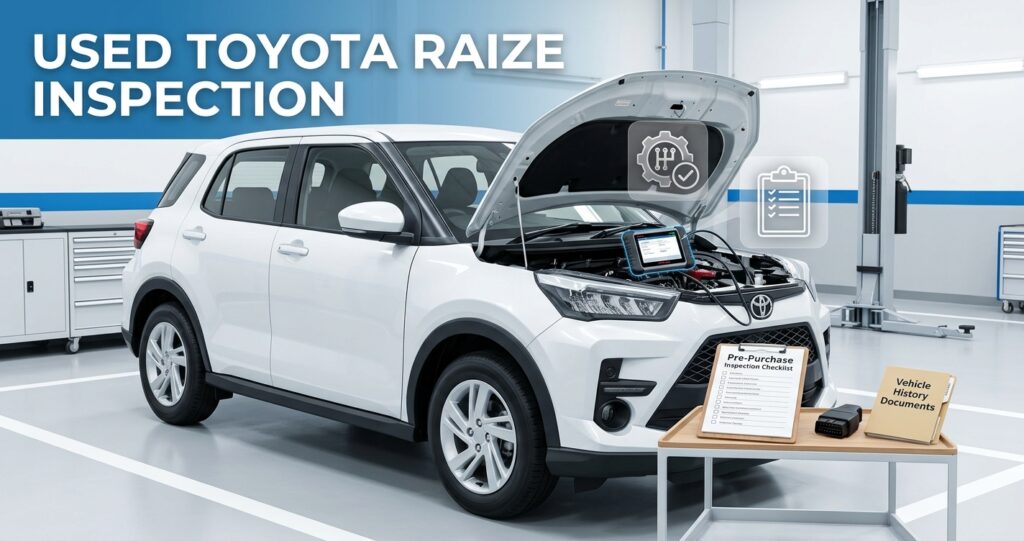
Used Toyota Raize Inspection Guide What Buyers Need to Know
The Toyota Raize has become an appealing option for Pakistani buyers seeking a compact SUV with modern styling, practical dimensions, and efficient fuel consumption. Available in different engine configurations and trim levels, it offers a balance of everyday usability and contemporary features. However, purchasing a used Raize requires more than checking its exterior condition or comparing prices in the local market.
Whether the vehicle was purchased locally or imported from Japan, its mechanical condition, maintenance history, accident record, and documentation can significantly influence its long-term value. A car that looks immaculate may still have concealed mechanical faults, previous collision damage, or an inconsistent service history.
A thorough used Toyota Raize inspection helps buyers identify potential problems before committing their money. From evaluating the engine condition to conducting a detailed CVT inspection, the following checklist covers the essential areas to examine before buying a used Toyota Raize in Pakistan.
1. Check the Engine Condition Carefully
The engine is one of the most important components to inspect before purchasing a used vehicle. Depending on the variant, the Toyota Raize may feature a 1.0-litre turbocharged petrol engine or a 1.2-litre naturally aspirated petrol engine. Some Japanese-market versions also have different powertrain configurations, so buyers should confirm the exact specification of the vehicle under consideration.
Start by inspecting the engine when it is cold. A seller who warms up the vehicle before your arrival may unintentionally or deliberately make certain starting problems less noticeable.
Pay attention to the following signs:
-
Cold starting: The engine should start without excessive cranking, unusual knocking, or persistent rattling.
-
Exhaust smoke: Blue smoke can indicate oil consumption, while persistent white smoke after the engine reaches operating temperature may suggest a coolant-related problem. Black smoke can indicate an excessively rich fuel mixture.
-
Oil leaks: Examine the engine cover area, seals, sump, and surrounding components for fresh oil residue.
-
Coolant condition: Check the coolant reservoir for an appropriate fluid level and signs of contamination.
-
Engine noise: Listen for irregular knocking, metallic rattling, or other abnormal sounds.
-
Dashboard warnings: Confirm that the check-engine light and other warning indicators behave normally during startup and disappear as expected.
A clean engine bay is not proof of good mechanical health. It may simply have been washed before the sale. A professional mechanic should scan the engine control unit for diagnostic trouble codes and inspect any suspicious areas.
For turbocharged variants, the inspection should also cover turbocharger performance, boost delivery, oil leakage, and unusual whistling sounds. These checks are particularly valuable when buying a vehicle with high mileage or an uncertain maintenance history.
2. Perform a Detailed CVT Inspection
Many Toyota Raize petrol variants use a continuously variable transmission (CVT), making transmission condition another critical consideration. However, the exact transmission depends on the model and powertrain, so confirm the vehicle’s specification before arranging the inspection.
A healthy CVT should deliver smooth, predictable acceleration without persistent shuddering, harsh engagement, or abnormal mechanical noises.
During the inspection, check the following:
-
Gear engagement: Shift between Park, Reverse, and Drive while the vehicle is stationary and the brakes are applied. Engagement should occur without excessive delay or a pronounced impact.
-
Acceleration: Drive the vehicle at different speeds and observe whether power delivery remains smooth.
-
Unusual vibrations: Watch for shuddering during acceleration or when moving away from a stop.
-
Transmission noise: Listen for excessive whining, grinding, or other noises that change with vehicle speed.
-
Warning indicators: Check for transmission-related warnings and stored diagnostic codes.
-
Maintenance evidence: Ask whether the transmission fluid has been serviced according to the correct manufacturer specifications.
A CVT does not behave exactly like a conventional automatic transmission. Engine speed may remain relatively steady while vehicle speed increases, which is normal in many driving situations. This characteristic should not automatically be mistaken for a fault.
Nevertheless, persistent hesitation, severe vibration, or abnormal noises warrant further investigation. Transmission repairs can be expensive, particularly when specialised parts are required. A qualified technician familiar with the specific Raize transmission should assess any questionable behaviour before the purchase.
3. Verify the Auction History and Original Condition
For Japanese-imported vehicles, auction documentation can provide valuable information about the car’s condition before export. It may reveal previous damage, repair work, interior wear, corrosion, and other observations recorded during the auction inspection.
However, an auction sheet is a historical document, not a guarantee of the vehicle’s current condition. Its value depends on authenticity, accurate interpretation, and consistency with the car being inspected.
Buyers should examine the following details:
-
Auction grade: Understand what the grade indicates about the vehicle’s overall condition, while recognising that grading systems and assessment criteria can vary.
-
Accident and repair indicators: Review any recorded structural damage, replaced panels, or previous repairs.
-
Mileage information: Compare the recorded mileage with available inspection documents and the current odometer reading.
-
Interior condition: Check whether the recorded interior grade corresponds with the seats, dashboard, carpets, and other cabin components.
-
Inspection remarks: Have any Japanese notes or technical observations translated and explained by someone familiar with auction terminology.
-
Vehicle identification: Confirm that the chassis or frame number corresponds with the vehicle and associated documents.
For buyers who want to understand how Japanese auction purchases work, reviewing reliable information about auction history can help clarify the role of auction records in assessing imported vehicles.
If the seller provides an auction sheet, verify it through a credible source rather than relying solely on a screenshot. A discrepancy between the document and the vehicle’s actual condition should be investigated before negotiations continue.
4. Inspect the Body for Accident Damage
A used Toyota Raize may look attractive after professional repainting, but cosmetic repairs can conceal more substantial damage. A systematic body inspection helps distinguish ordinary wear from signs of a previous collision.
Begin by checking the exterior in daylight. Examine the paint under different angles and compare the colour and finish across adjacent panels. Differences in texture, overspray, uneven reflections, or inconsistent panel gaps can indicate previous repair work.
Give particular attention to:
-
Front and rear bumpers
-
Bonnet and boot or tailgate
-
Front and rear fenders
-
Doors and door pillars
-
Roof and windscreen edges
-
Chassis rails and visible structural sections
-
Headlights, taillights, and mounting points
Look for irregular welds, fresh sealant, distorted metal, or signs that structural components have been replaced. These observations do not automatically prove serious accident damage, but they justify a closer professional examination.
Also inspect the windscreen and windows for cracks, replacement markings, and inconsistent fitting. Replaced glass can result from routine damage, so it should be considered alongside other evidence rather than treated as conclusive proof of a collision.
Where possible, ask a qualified inspector to use a paint-thickness gauge and examine the vehicle on a lift. Structural integrity matters more than a flawless finish, particularly when the car will be driven regularly on Pakistan’s mixed road conditions.
5. Examine Service Records and Maintenance History
Service records help establish whether the previous owner maintained the vehicle consistently. They can also highlight recurring problems that may not be obvious during a short test drive.
Request available maintenance invoices, workshop records, inspection reports, and Japanese export documents. If the car has been driven in Pakistan for some time, ask for local servicing receipts as well.
Look for evidence of:
-
Regular engine oil and filter changes
-
Correct specification of engine oil and transmission fluid
-
Air filter and cabin filter replacement
-
Brake pad and disc maintenance
-
Coolant inspection and replacement where required
-
Spark plug servicing at the appropriate interval
-
Battery replacement and electrical repairs
-
Previous engine, transmission, or suspension work
Compare the dates and mileage recorded on the invoices with the odometer reading. Gaps in the records do not necessarily mean the car was neglected, but they increase uncertainty and may justify a more comprehensive mechanical inspection.
For Japanese imports, some maintenance may have been completed before the vehicle arrived in Pakistan. Ask the seller for any available Japanese-language records and have them translated when necessary.
A vehicle with consistent documentation may be a safer purchase than a similar car with an attractive appearance but no verifiable maintenance history.
6. Test the Brakes, Suspension, and Steering
Road conditions in Pakistan can place considerable demands on suspension components, tyres, and steering systems. Potholes, uneven surfaces, and repeated braking can accelerate wear, making these systems essential parts of the inspection.
During a test drive, assess the braking response on a safe, clear road. The vehicle should slow down predictably without excessive pedal vibration, pulling to one side, or unusual noises.
Inspect the following components:
-
Brake pads and discs for excessive wear
-
Shock absorbers for leakage
-
Suspension bushes and joints for looseness
-
Steering components for excessive play
-
Wheel bearings for humming or grinding
-
Tyres for uneven wear, cracks, or bulges
Drive over a mild road imperfection at a sensible speed and listen for knocking or rattling. Persistent suspension noise may indicate worn bushes, links, or other components requiring attention.
The steering should feel consistent, without excessive vibration or a tendency to drift on a reasonably level road. Uneven tyre wear can result from alignment problems, incorrect tyre pressure, worn suspension components, or previous collision damage.
Before buying, inspect the spare tyre, jack, wheel tools, and tyre manufacturing dates where applicable. These details are easy to overlook but contribute to the vehicle’s overall condition and immediate usability.
7. Check the Hybrid System if Applicable
Some Japanese-market Toyota Raize models use a hybrid powertrain, so buyers should not assume that every vehicle has the same mechanical configuration. Confirm whether the specific car is petrol-only or hybrid before evaluating its systems.
For a hybrid model, arrange a diagnostic assessment by a technician familiar with Toyota hybrid systems. The inspection should cover the high-voltage battery, battery management system, cooling arrangements, inverter-related components, and stored fault codes.
Pay attention to:
-
Hybrid system warning lights
-
Abnormal changes in battery charge indications
-
Unusual cooling fan noise
-
Evidence of previous electrical repairs
-
Available hybrid battery diagnostic results
A dashboard display alone cannot establish the long-term health of a hybrid battery. Request appropriate diagnostic information instead of relying on a seller’s verbal assurance.
Also verify that the vehicle’s maintenance requirements and available replacement parts are suitable for your intended ownership period. A hybrid may offer fuel-efficiency advantages, but its overall value depends on the condition of the entire powertrain and the cost of maintaining it.
8. Test the Air Conditioning and Electrical Features
Pakistan’s hot summers make effective air conditioning particularly important. Start the system and allow it to run long enough to assess its cooling performance rather than judging it immediately after switching it on.
Check the following features individually:
-
Air conditioning and blower speeds
-
Heating and ventilation controls, where fitted
-
Power windows and door locks
-
Infotainment screen and audio system
-
Reversing camera and parking sensors
-
Headlights, indicators, and brake lights
-
Instrument cluster and warning indicators
-
Keyless entry and push-button start, if equipped
-
Electronic driver-assistance features, where fitted
Inspect the battery terminals for corrosion and look for signs of amateur wiring modifications. If the vehicle has been involved in a collision, ensure that the relevant airbags and restraint systems are present and that the airbag warning light functions correctly.
A diagnostic scan can help identify electrical faults that are not immediately apparent. This is especially useful when the vehicle has numerous electronic features or an unclear repair history.
9. Confirm Mileage, Chassis Number, and Import Documents
Mechanical condition is only one part of a sound purchase. Buyers should also confirm that the vehicle’s identity and paperwork are consistent.
Check the chassis or frame number on the vehicle against the available import and registration documents. Examine the number for signs of tampering, alteration, or suspicious inconsistencies.
For imported vehicles, request the relevant documentation, which may include:
-
Japanese export or deregistration documents
-
Customs clearance records
-
Bill of lading or shipping documentation, where available
-
Auction and inspection records
-
Local registration book or smart card, if already registered
-
Applicable import and tax documents
-
Transfer and ownership documentation
Requirements vary depending on the vehicle’s import route, registration status, and applicable Pakistani regulations. Confirm the current requirements with the relevant registration authority and verify that any outstanding taxes, duties, or transfer obligations have been addressed.
Odometer readings should be assessed alongside service records, inspection documents, and the physical condition of the cabin and controls. Excessive wear on the steering wheel, pedals, and driver’s seat can raise questions, although these signs alone cannot establish whether mileage has been altered.
Do not complete the transaction until the vehicle’s identity, ownership, and legal status have been satisfactorily verified.
10. Take the Toyota Raize for a Proper Test Drive
A test drive brings together many of the observations made during the stationary inspection. Ideally, drive the car when the engine is cold initially, then continue until it reaches normal operating temperature.
Choose a safe route that includes ordinary urban driving and a section where moderate acceleration is possible. Avoid aggressive driving or manoeuvres that could put anyone at risk.
During the drive, assess:
-
Engine responsiveness and idle quality
-
CVT or other transmission behaviour
-
Braking stability and pedal feel
-
Steering accuracy and vehicle tracking
-
Suspension comfort and unusual noises
-
Air conditioning performance
-
Dashboard warning lights
-
Vibration at different speeds
After the drive, park the car safely and inspect the engine bay again for fresh leaks or unusual smells. Check whether the cooling system appears to be operating normally and whether any warning lights have appeared.
A short drive cannot reveal every possible fault. If the seller refuses a reasonable test drive or an independent inspection, treat that reluctance as a reason to reconsider the purchase.
11. Compare the Asking Price with the Vehicle’s Actual Condition
The cheapest Toyota Raize is not necessarily the best value. A lower price may reflect higher mileage, accident repairs, missing documentation, deferred maintenance, or an undesirable specification.
Before negotiating, compare similar vehicles by model year, engine type, trim, mileage, registration status, and overall condition. For imported vehicles, consider the original auction assessment and the quality of any subsequent repairs.
Calculate the likely immediate expenses, including:
-
Mechanical repairs identified during inspection
-
Tyres, brakes, and suspension work
-
Routine servicing and replacement fluids
-
Registration or transfer costs, where applicable
-
Missing accessories or documentation-related expenses
Use the findings to negotiate fairly. Minor cosmetic imperfections may justify a modest adjustment, while uncertain structural repairs or major transmission problems deserve more serious consideration.
For a broader comparison of variants, specifications, and import-related expenses, consult this Toyota Raize buyer’s guide before deciding which vehicle fits your budget.
Final Checklist Before Buying a Used Toyota Raize
Use this quick checklist before making a final offer.
Conclusion
Buying a used Toyota Raize in Pakistan can be a practical decision, provided the vehicle is evaluated beyond its appearance and advertised specifications. Engine condition, transmission performance, accident history, maintenance documentation, and legal paperwork all influence whether a particular car represents good value.
A comprehensive used Toyota Raize inspection should combine a physical examination, a proper road test, diagnostic checks, and document verification. Japanese auction records can provide useful historical evidence, but they should always be compared with the vehicle’s current condition.
Most importantly, do not rely exclusively on the seller’s assurances or the car’s apparent cleanliness. An independent inspection before payment can reveal costly problems, strengthen your negotiating position, and help you choose a Toyota Raize that is better suited to long-term ownership.