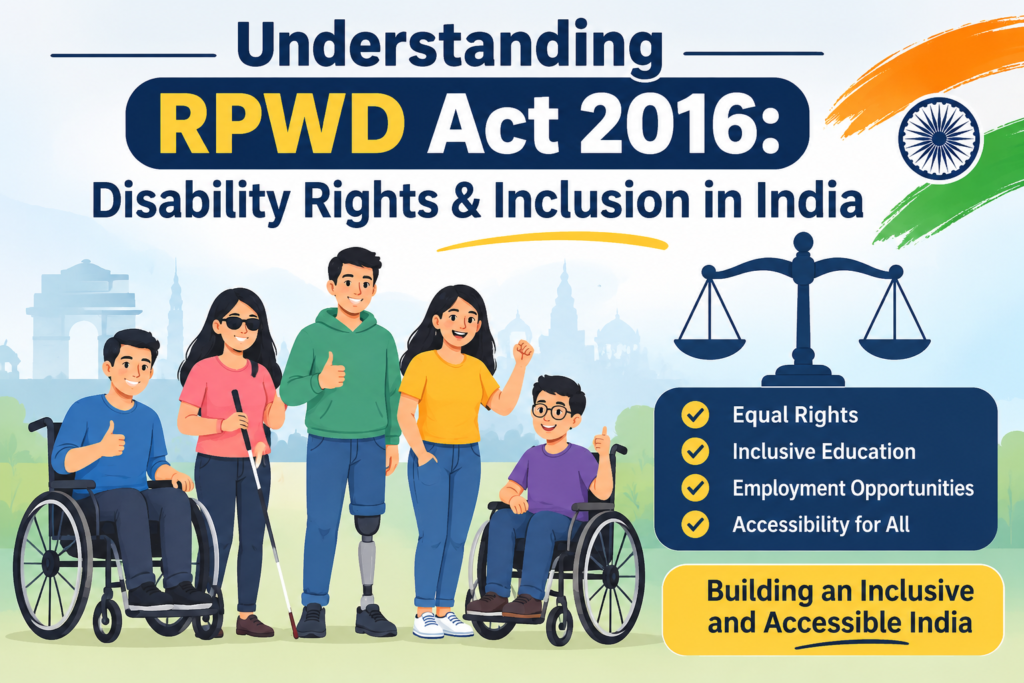
Understanding RPWD Act 2016 in India
Every individual deserves equal opportunities, respect, and the freedom to participate in society, regardless of their abilities. However, people with disabilities often face challenges in education, employment, transportation, healthcare, and access to public services. To address these barriers and promote equal rights, the Government of India introduced the Rights of Persons with Disabilities (RPWD) Act, 2016.
The RPWD Act 2016 is an important step toward creating an inclusive society where people with disabilities can live independently and enjoy equal opportunities. It focuses on protecting their fundamental rights, preventing discrimination, and improving accessibility across different sectors.
What Is the RPWD Act 2016?
The Rights of Persons with Disabilities Act, 2016, is Indian legislation designed to protect the rights and dignity of persons with disabilities. It replaced the Persons with Disabilities Act, 1995, and brought India’s disability rights framework in line with the United Nations Convention on the Rights of Persons with Disabilities (UNCRPD).
The Act was passed on December 27, 2016, and came into force on April 19, 2017. One of its major improvements was expanding the recognized categories of disabilities from seven to 21.
This legislation aims to ensure equality, non-discrimination, accessibility, education, employment, and social participation for persons with disabilities.
Key Objectives of the RPWD Act 2016
The primary objective of the RPWD Act 2016 is to create an environment where people with disabilities can exercise their rights without unnecessary restrictions.
Some important objectives include:
- Protecting the dignity and independence of persons with disabilities.
- Preventing discrimination in education, employment, and public services.
- Promoting equal opportunities and social participation.
- Improving access to transportation, buildings, and digital technology.
- Supporting inclusive education and professional development.
- Protecting individuals from abuse, exploitation, and unfair treatment.
These objectives encourage governments, organizations, educational institutions, and businesses to adopt more inclusive practices.
Major Rights and Provisions Under the RPWD Act
1. Right to Equality and Non-Discrimination
Section 3 of the RPWD Act establishes equality and non-discrimination as essential rights. Persons with disabilities should receive equal treatment, dignity, and opportunities in society.
Organizations and institutions should avoid discriminatory practices and provide reasonable accommodations where required.
2. Inclusive Education
Education is essential for personal development and independence. The Act encourages educational institutions to provide inclusive learning environments for students with disabilities.
Schools and colleges should work toward accessible classrooms, appropriate learning materials, trained educators, and necessary support systems.
The Act also provides free education for children with benchmark disabilities between six and eighteen years of age.
3. Employment Opportunities
Employment plays an important role in financial independence and social participation. The RPWD Act promotes equal employment opportunities and prohibits discrimination in government employment.
It also provides for a 4% reservation in government jobs for persons with benchmark disabilities and encourages suitable workplace accommodations.
4. Accessibility in Public Spaces and Digital Technology
Accessibility is one of the most important aspects of disability inclusion. The Act addresses accessibility in buildings, transportation, information, and communication technology.
Public infrastructure and digital services should be designed to accommodate people with different disabilities.
For example, accessible websites, screen-reader compatibility, keyboard navigation, captions, and clear content structures can help people with disabilities use digital platforms independently.
5. Protection Against Abuse and Exploitation
The Act includes provisions to protect persons with disabilities from cruelty, violence, abuse, and exploitation. It also recognizes their rights to family life, community participation, healthcare, and personal dignity.
These protections help create a safer and more supportive environment.
Why Is the RPWD Act 2016 Important for Digital Accessibility?
As technology becomes part of everyday life, digital accessibility is essential for equal participation. People with visual, hearing, physical, and cognitive disabilities should be able to access websites, mobile applications, online education, and digital services.
Businesses and website owners can contribute by following accessibility standards such as the Web Content Accessibility Guidelines (WCAG).
Accessible design features, including alternative text for images, captions for videos, readable fonts, sufficient color contrast, and keyboard-friendly navigation, can make digital experiences more inclusive.
Companies such as Accessible Minds support the broader goal of digital inclusion by promoting awareness and accessible technology practices.
How Organizations Can Support Disability Inclusion
Organizations can help implement the principles of the RPWD Act through practical initiatives, including:
- Making websites and mobile applications accessible.
- Providing disability-friendly workplace environments.
- Offering equal recruitment and career development opportunities.
- Training employees about disability awareness.
- Improving accessibility in offices and public facilities.
- Consulting people with disabilities when developing products and services.
These initiatives can help organizations build a culture of equality, respect, and inclusion.
Conclusion
The RPWD Act 2016 represents an important milestone in protecting disability rights and promoting equality in India. By addressing discrimination, improving accessibility, and supporting inclusive education and employment, the legislation creates opportunities for people with disabilities to participate more fully in society.
However, meaningful inclusion requires more than legal protection. Governments, businesses, educational institutions, and individuals must work together to remove physical, social, and digital barriers.
Building an accessible future starts with recognizing that everyone deserves equal opportunities. By following the principles of the RPWD Act, India can move toward a more inclusive society where accessibility, dignity, and equality are available to everyone.