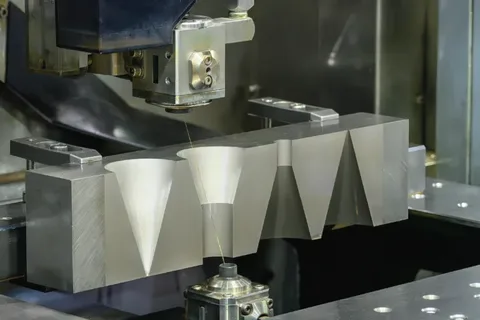
In modern manufacturing, precision and efficiency are critical factors that determine production success. One of the most advanced technologies enabling manufacturers to achieve both is wire EDM machining. This non-traditional machining process uses a thin electrically charged wire to cut through conductive materials with extreme accuracy, making it ideal for complex and high-precision parts.
As industries continue to demand tighter tolerances and faster production cycles, wire EDM machining has evolved with advanced controls, automation, and smarter cutting strategies. These improvements help manufacturers reduce waste, improve surface finishes, and produce intricate components that are difficult or impossible to achieve with conventional machining methods. This article explores how advanced wire EDM machining maximizes efficiency across different manufacturing environments.
Understanding Advanced Wire EDM Machining
Advanced wire EDM machining (Electrical Discharge Machining) is a process where controlled electrical sparks erode material from a workpiece. Instead of mechanical cutting tools, it relies on thermal energy generated between the wire electrode and the conductive material. This makes it highly effective for hard metals like titanium, tungsten, and tool steels.
Modern systems have significantly improved speed, accuracy, and automation. Today’s wire edm machining technology integrates CNC controls, adaptive power settings, and real-time monitoring, ensuring optimal cutting performance even in complex geometries.
Key Points:
- Uses electrical discharges instead of physical cutting tools
- Suitable for hard, conductive materials
- Produces highly precise and intricate shapes
- Minimizes mechanical stress on the workpiece
- Integrates CNC automation for improved accuracy
The evolution of this technology has made it a preferred choice in aerospace, medical, and automotive industries where precision is non-negotiable. Advanced software allows operators to program detailed cutting paths, reducing human error and improving repeatability across production runs.
Additionally, improvements in dielectric systems and wire materials have enhanced cutting speed and surface finish quality. This ensures that manufacturers can achieve both efficiency and superior part quality simultaneously.
Key Benefits of Wire EDM Machining in Modern Manufacturing
One of the primary advantages of wire EDM machining is its ability to produce highly accurate components with tight tolerances. This is especially important in industries where even microscopic deviations can lead to performance failures.
Another major benefit is the ability to machine complex geometries without additional finishing processes. With wire edm machining, manufacturers can reduce secondary operations, saving both time and cost.
Key Points:
- Exceptional precision and tight tolerance control
- No physical tool contact reduces wear and tear
- Ideal for complex and delicate shapes
- Reduces need for secondary finishing operations
- Improves consistency across large production batches
Because there is no direct contact between tool and material, there is minimal mechanical stress or distortion. This is especially useful for fragile or thin-walled parts that could deform under traditional machining methods.
Furthermore, wire EDM machining is highly repeatable, meaning manufacturers can produce identical parts in large quantities without variation. This consistency is crucial for industries like aerospace and medical device manufacturing.
Industrial Applications of Wire EDM Machining
Wire EDM machining is widely used across multiple industries due to its versatility and precision. It plays a crucial role in producing components that require fine detailing and superior accuracy.
In aerospace, it is used for turbine components, engine parts, and structural elements. In the medical field, wire edm machining helps produce surgical instruments and implantable devices that require extreme precision.
Key Points:
- Aerospace: turbine blades, engine components
- Medical: surgical tools, implants
- Automotive: injection molds, transmission parts
- Electronics: micro-components and connectors
- Tool and die making: precision molds and dies
The automotive industry relies heavily on this technology for producing injection molds and high-performance engine components. These parts often require tight tolerances and complex geometries that wire EDM machining handles efficiently.
In electronics manufacturing, it is used to create miniature components with high accuracy. As devices continue to shrink in size, the demand for precision machining continues to grow, making wire EDM an essential process.
Techniques to Maximize Efficiency in Wire EDM Machining
Maximizing efficiency in wire EDM machining requires a combination of proper machine setup, optimized parameters, and skilled programming. Small adjustments in cutting speed, wire tension, and power settings can significantly impact performance.
Modern machines equipped with adaptive control systems can automatically adjust cutting parameters based on material thickness and conductivity. This makes wire edm machining more efficient and reduces operator intervention.
Key Points:
- Optimize cutting parameters for different materials
- Use high-quality wire for better stability
- Maintain proper dielectric fluid conditions
- Employ automated CNC programming systems
- Schedule preventive maintenance for machines
Using high-quality wire electrodes improves cutting stability and reduces breakage, leading to fewer interruptions during production. Additionally, maintaining clean and properly filtered dielectric fluid ensures consistent spark generation.
Preventive maintenance also plays a vital role in efficiency. Regular calibration and inspection of machine components help avoid unexpected downtime and maintain high precision throughout production cycles.
Future Trends in Wire EDM Machining Technology
The future of wire EDM machining is closely tied to advancements in automation, artificial intelligence, and smart manufacturing systems. These innovations are making the process faster, more accurate, and more energy-efficient.
One of the emerging trends is the integration of AI-driven optimization systems that analyze cutting conditions in real time. This allows wire edm machining systems to automatically adjust parameters for maximum efficiency.
Key Points:
- AI-based process optimization
- Increased automation and unmanned machining
- Smarter energy-efficient systems
- Integration with Industry 4.0 technologies
- Enhanced real-time monitoring and diagnostics
Another trend is the rise of fully automated manufacturing cells where wire EDM machines operate continuously with minimal human intervention. This significantly increases productivity while reducing labor costs.
Additionally, data-driven manufacturing systems are enabling predictive maintenance, which helps identify potential machine issues before they cause downtime. These innovations are shaping the future of precision machining.
Conclusion
Advanced wire EDM machining has become an essential technology in modern manufacturing due to its unmatched precision, versatility, and efficiency. As industries continue to demand higher accuracy and faster production, wire edm machining offers a reliable solution that meets these evolving requirements.
From aerospace and automotive to medical and electronics industries, its applications are vast and continuously expanding. With ongoing advancements in automation, AI integration, and machine control systems, the future of wire EDM machining promises even greater efficiency and capability.
By adopting best practices and leveraging modern technologies, manufacturers can fully maximize the benefits of this powerful machining process and stay competitive in today’s demanding industrial landscape.