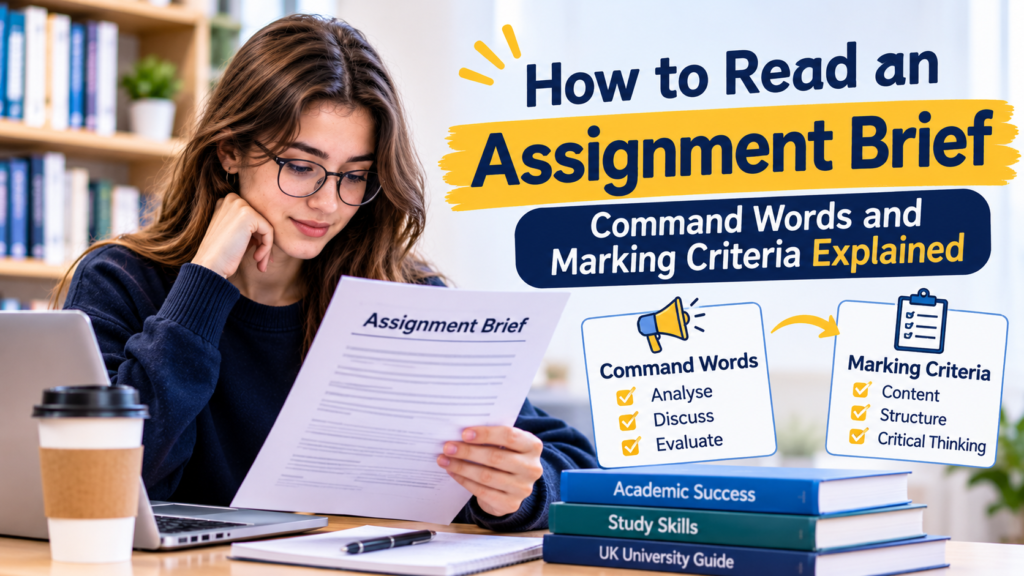
To read an assignment brief, find the command word (such as evaluate or discuss), the topic, and any limits on scope. Then read the learning outcomes and marking criteria to see what earns the marks. Finally, rewrite the task in your own words and check it with your tutor before you start writing.
The brief is the only document in your degree that tells you, in writing, exactly what the marker wants. Yet most students skim it once, start reading, and only reopen it the night before submission. This guide shows how to read it properly: what each part means, how command words set the level of thinking, and how to turn marking criteria into a plan.
What’s in a UK Assignment Brief?
Layouts vary between universities, but most briefs contain the same parts. Each one answers a different question for you.
| Part of the brief | What it tells you | What to do with it |
|---|---|---|
| Task or question | What you must answer | Mark the command word, topic and limits |
| Learning outcomes | The skills the module is testing | Make sure each is visible in your work |
| Marking criteria or rubric | How marks are awarded, often with weightings | Plan your time around the heaviest criteria |
| Format and word count | Essay, report or reflection; length and tolerance | Set your structure and word budget |
| Referencing and sources | Required style and any source expectations | Set up your reference list from day one |
| Academic integrity and AI rules | What help and tools are allowed | Check what you must declare |
| Deadline and submission | Date, time and upload route | Diary it with the exact time |
How to Read an Assignment Brief in 5 Steps
Take a typical question:
Critically evaluate the extent to which flexible working has improved employee productivity in UK SMEs since 2020. (2,000 words)
1. Read it once, all the way through
Read the whole brief before taking notes, including the rubric and the small print at the end. Students who skip straight to the question miss the weightings.
2. Mark up the question
Circle the command words, underline the topic, and box every limit. In the example:
- Command words: critically evaluate and the extent to which. You must reach a judgement, not just describe.
- Topic: flexible working and employee productivity.
- Limits: UK, SMEs only, and since 2020. Evidence from large firms or before 2020 is context at most.
3. Map the marking criteria onto a plan
If critical analysis carries 40% of the marks and presentation 10%, your hours should follow the same split.
4. Rewrite the task in one sentence
For the example: “Judge how far flexible working has raised productivity in UK small firms since 2020, and say why.” If you cannot do this, you do not yet understand the brief.
5. Check your reading with your tutor early
Email your one-sentence version to your module tutor in the first week.
Command Words by Level of Thinking
Command words are not interchangeable. They climb in difficulty, from recalling information to judging it, and the marks climb with them.
| Level | Command words | What your paragraphs must contain |
|---|---|---|
| 1. Show what you know | Describe, outline, identify, define | Accurate, relevant facts, briefly |
| 2. Show you understand | Explain, illustrate, interpret | Causes, reasons and examples |
| 3. Break it down | Analyse, examine, compare, contrast | Parts, relationships, similarities and differences |
| 4. Make a judgement | Evaluate, assess, critically analyse, to what extent, justify | Evidence weighed against counter-evidence, and a clear verdict |
The most common mistake is answering a level 4 question at level 1 or 2: a well-researched description of flexible working, with no verdict on productivity. It may be accurate, but it is not what was asked.
How to Read Marking Criteria and Rubrics
Marking criteria are the most useful part of any assignment brief, and the most often misunderstood. In the latest National Student Survey results, 80.6% of final-year students said the marking criteria used on their work were clear. That is the lowest of the three assessment questions, behind fair marking (85.5%) and assessments that let students show what they learned (86.1%). That leaves about one student in five unsure what earns marks.
To read a rubric well:
- Start with the weightings. They tell you where the marks are.
- Read the 70+ column first. It describes the work you are aiming for, in the marker’s own words.
- Compare neighbouring bands. The difference often sits in one word: sustained versus some critical analysis, or wide versus adequate reading.
- Turn each top-band phrase into a question. “Is my critical analysis sustained across every section, or only in one?”
Case Study: 90 Minutes With the Marking Criteria
The study. Oxford Brookes researchers Chris Rust, Margaret Price and Berry O’Donovan published this in Assessment and Evaluation in Higher Education in 2003 (full paper). On a first-year business module of over 300 students, everyone was given two sample assignments and the real marksheet to grade them. About half then attended a 90-minute workshop to compare grades, hear each criterion explained and see the tutor’s annotated marking.
The result. Before the workshop, attenders and non-attenders scored almost identically: 58.6 against 57.8. On the module where it ran, attenders averaged 59.78 and non-attenders 54.12. One year later, on a module with a similar task and criteria, the gap was still there: 57.91 against 51.3. A second cohort the following year repeated the effect, at 59.86 against 52.86.
What this means for you. The students who improved did not get extra teaching on content. They learned to see their work the way a marker does. You can copy the method: ask your tutor for an exemplar, mark it against the rubric yourself, then compare your judgement with the tutor’s. The authors note the long-term gain was measured on a similar task, so it may transfer less well to very different assessments.
Assignment Brief Checklist
- I have read the whole brief, including the rubric and small print
- I have circled every command word and know its level
- I have boxed every limit: place, period, theory or sector
- I know which criteria carry the most marks
- I have read the top-band descriptor for each criterion
- I can state the task in one sentence
- I know the word count, tolerance, format and referencing style
- I know what AI or outside help I must declare
- I have confirmed my reading with my tutor
When to Ask for Help With a Brief
Your module tutor is the final authority on what a brief means, so ask them first, and in writing.
The problem is timing. Briefs are often reread late at night, when office hours are long over. That is where 24/7 assignment help UK services fill a gap, and they are lawful when they work like a tutor: explaining command words, reviewing your one-sentence task, or checking your plan against the criteria.
They are not lawful when they write the assignment. The Skills and Post-16 Education Act 2022 made it a criminal offence to provide or advertise essay mill services for money to students in England. Use outside help to understand the brief; never to replace your answer to it.
Conclusion
An assignment brief is a set of instructions for earning marks, and most of them are written down. Find the command words to see what level of thinking is required, box the limits, and read the marking criteria from the top band down. Then rewrite the task in one sentence and check it with your tutor. As the Oxford Brookes research shows, students who learn to read the criteria the way markers do score higher, and the advantage lasts.
Frequently Asked Questions
What is an assignment brief?
An assignment brief is the document that sets out a university task: the question, learning outcomes, marking criteria, word count, format, referencing style and deadline. It is the official statement of what your work will be marked against.
What are command words in an assignment?
Command words are the instruction words in a question, such as describe, analyse or evaluate. They tell you what to do with the topic and how deep your thinking must go.
What does “critically evaluate” mean?
It means weighing the strengths and weaknesses of the evidence and arguments, then reaching a reasoned judgement. A critical evaluation must end with a clear verdict, not a summary.
What is the difference between learning outcomes and marking criteria?
Learning outcomes describe what the module expects you to be able to do. Marking criteria describe how well you have done it, and how many marks each level earns.
What should I do if I don’t understand my assignment brief?
Rewrite the task in one sentence and email it to your module tutor to check. You can also ask your university’s study skills team to talk you through the marking criteria.