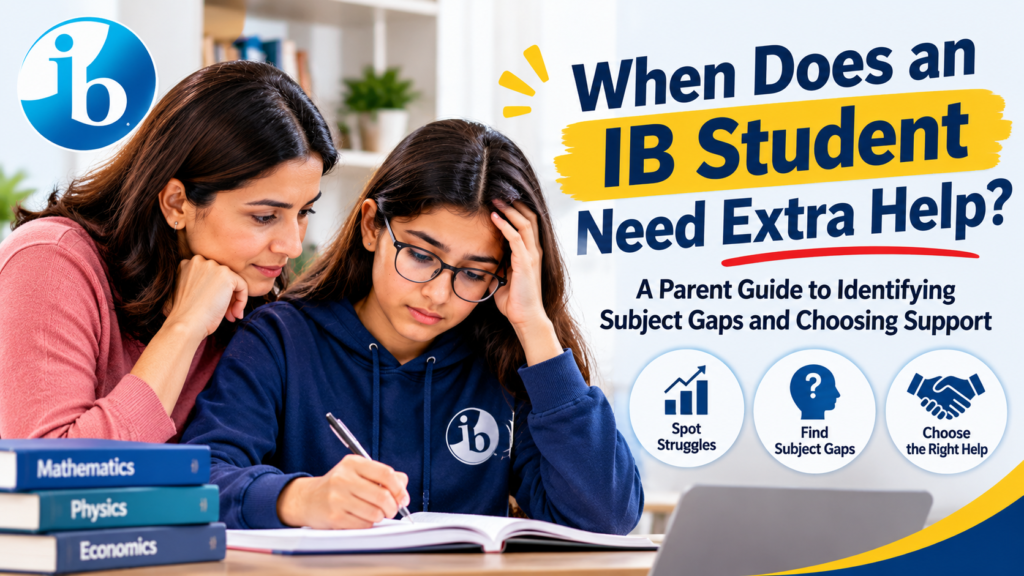
The International Baccalaureate (IB) Diploma Programme is an academically demanding qualification that encourages students to think critically, manage independent learning and develop a broad understanding of different subjects. While many students enjoy the challenge, balancing multiple subjects, coursework, internal assessments and examination preparation can sometimes become overwhelming.
For parents, it is not always easy to recognise when a student is struggling. A teenager may say that everything is fine, even when their grades are falling, assignments are taking longer than expected or they are losing confidence in a particular subject.
The important thing is to identify academic difficulties early. A student does not need to wait until examination results are disappointing before receiving additional support. Sometimes, a few targeted lessons or a more structured study routine can make a meaningful difference.
This guide explains when an IB student may need extra academic help, how parents can identify subject gaps and what to consider when choosing suitable support.
Understanding Why IB Students Sometimes Need Extra Help
The IB Diploma Programme involves more than memorising information and preparing for examinations. Students are expected to understand concepts, apply knowledge, evaluate arguments and communicate their ideas effectively.
They also need to manage different academic responsibilities, including:
- Six subjects across different academic areas.
- Internal Assessments (IAs) in relevant subjects.
- Extended Essay (EE) research and writing.
- Theory of Knowledge (TOK) tasks.
- Creativity, Activity, Service (CAS) commitments.
- Regular assignments, tests and examination preparation.
Managing all these responsibilities requires organisation, consistency and independent learning skills.
Some students may perform well in classroom discussions but struggle when applying concepts to examination questions. Others may understand the syllabus but find it difficult to organise their answers or complete assignments within deadlines.
These challenges do not necessarily indicate a lack of ability. They may simply show that a student needs a different learning approach, more practice or additional guidance.
7 Signs Your Child May Need Extra IB Academic Support
Parents should pay attention to changes in academic performance, study habits and confidence. One difficult test does not automatically mean that a student needs tutoring, but repeated problems may indicate an underlying subject gap.
1. Consistently Declining Subject Grades
A noticeable drop in grades is one of the clearest signs that a student may need additional support.
For example, a student who previously achieved good results in Mathematics may begin receiving lower marks in topic tests, assignments and mock examinations.
This can happen because later topics often build on concepts introduced earlier. If a student does not understand an important foundation, more advanced material can become increasingly difficult.
Parents should look beyond the overall predicted grade and identify which subjects or assessment areas are causing problems.
2. Difficulty Understanding Important Concepts
Some students spend considerable time studying but still struggle to explain important concepts.
They may memorise definitions and formulas without understanding how to apply them in unfamiliar situations. This becomes particularly challenging in IB examinations, where questions often require interpretation, analysis and application.
For example:
- Mathematics students may struggle to apply formulas to unfamiliar problems.
- Biology students may remember terminology but find data-based questions difficult.
- Chemistry students may understand basic reactions but struggle with calculations.
- Economics students may know definitions but find evaluation and application challenging.
- Psychology students may remember studies but struggle to connect evidence with theoretical arguments.
If a student repeatedly encounters the same difficulties, targeted subject support may help strengthen their understanding.
3. Spending Too Much Time on Homework
Long study hours do not always indicate effective learning.
If your child spends several hours completing one assignment, repeatedly checks the same notes or cannot finish homework without assistance, there may be gaps in their understanding or study methods.
The problem could involve:
- Difficulty understanding instructions.
- Weak foundational knowledge.
- Poor time management.
- Lack of confidence when solving questions independently.
- Ineffective revision techniques.
Parents should consider whether the student is making progress during study time rather than focusing only on the number of hours spent studying.
4. Avoiding Particular Subjects
A student who regularly avoids one subject may be experiencing difficulties that they do not know how to communicate.
For instance, they may postpone Mathematics homework, become frustrated with Physics questions or avoid writing assignments in English.
This behaviour can sometimes develop because the student has lost confidence in their ability to complete the work.
Instead of assuming that the student is being careless, parents should try to understand what makes the subject difficult.
A supportive conversation can reveal whether the problem involves challenging topics, unclear explanations, assessment pressure or a lack of practice.
5. Struggling With Internal Assessments and Extended Essay Work
IB students need to develop independent research, writing and analytical skills.
Internal Assessments and the Extended Essay can be particularly challenging because students must understand assessment expectations, plan their work, interpret information and communicate their findings clearly.
Some common difficulties include:
- Choosing an appropriate research question.
- Developing a clear investigation.
- Finding and evaluating relevant sources.
- Organising arguments logically.
- Interpreting results and evidence.
- Following subject-specific assessment criteria.
- Managing deadlines.
If a student repeatedly struggles to move forward with coursework, they may benefit from guidance on planning, research methods and academic skills.
Support should help students understand the requirements and develop their own work rather than completing assessed work on their behalf.
6. Losing Confidence Before Tests and Examinations
Academic confidence can influence how students approach difficult subjects.
A student who previously participated actively in class may become reluctant to answer questions, avoid challenging exercises or feel anxious before tests.
Sometimes, these changes occur after repeated disappointing results.
Parents should look for patterns such as:
- Frequently saying that a subject is too difficult.
- Avoiding practice examinations.
- Becoming unusually frustrated during revision.
- Doubting their ability despite preparation.
- Feeling overwhelmed by the amount of material to study.
Encouragement and a clear learning plan can help students rebuild confidence gradually.
7. Falling Behind Across Multiple Subjects
A student may initially struggle with one subject, but the problem can become more serious when difficulties appear across several areas.
This may happen because the student is spending too much time trying to understand one subject and neglecting other responsibilities.
They may also have difficulty balancing coursework, extracurricular activities, revision and personal time.
When several subjects begin to suffer, parents should consider whether the issue is related to time management, workload, study routines or a broader need for academic support.

How Parents Can Identify Subject Gaps
Recognising that a student is struggling is only the first step. The next step is understanding exactly where the difficulties occur.
Instead of immediately arranging additional lessons for every subject, parents should work with the student to identify specific learning gaps.
Review Recent Test Results and Teacher Feedback
Start by looking at recent assessments, homework and teacher comments.
A student’s marks can reveal whether the problem is related to conceptual understanding, application, examination technique or written communication.
For example, a student may receive good marks for recalling information but lose marks when explaining processes or evaluating evidence.
Teacher feedback can provide useful information about recurring weaknesses and areas that require improvement.
Ask Your Child Which Topics Feel Difficult
A simple conversation can help parents understand what is happening.
Instead of asking only whether your child is struggling, try more specific questions:
- Which topics are difficult to understand?
- Do you find classroom explanations helpful?
- Can you solve practice questions without looking at the answers?
- Are you finding assignments difficult to complete?
- Do you feel prepared for upcoming assessments?
Avoid making the conversation feel like an examination. The aim is to help your child explain their difficulties honestly.
Compare Homework Performance With Examination Results
Some students complete homework successfully because they have access to textbooks, notes and online resources.
However, they may struggle when asked to solve questions independently during a timed examination.
This difference can indicate that the student understands basic concepts but needs more practice applying them without assistance.
Reviewing both homework and test performance can help parents identify whether the issue is knowledge, confidence or examination technique.
Look for Repeated Mistakes
One incorrect answer may not reveal much, but repeated mistakes can indicate a specific subject gap.
For example, a student may regularly lose marks because they:
- Misinterpret command terms such as evaluate, discuss or analyse.
- Skip important calculation steps.
- Use evidence without explaining its relevance.
- Provide descriptive answers when evaluation is required.
- Misunderstand graphs, tables or data.
- Fail to structure longer written responses.
Identifying these patterns allows students and teachers to focus on the areas that need attention.
When Should Parents Consider Hiring an IB Tutor?
Working with an experienced international baccalaureate tutor can help students identify subject gaps, strengthen their understanding and develop a more effective study routine.
Extra support can be useful when a student needs more individual attention than they are currently receiving.
However, tutoring should be based on a clear academic need rather than the assumption that every IB student requires additional lessons.
Parents may consider professional support in the following situations.
When a Student Has Persistent Subject Difficulties
If a student repeatedly struggles with a particular subject despite attending classes and completing homework, individual academic guidance may help.
A tutor can identify misunderstandings, explain difficult concepts using alternative methods and provide practice questions suited to the student’s current level.
This can be especially useful in subjects where later topics depend heavily on earlier knowledge.
When Examination Preparation Is Not Producing Results
Some students revise regularly but do not see improvements in their test scores.
The problem may be related to ineffective revision techniques, limited examination practice or difficulty understanding how questions are marked.
A tutor can help students develop a more structured preparation routine, practise past-paper questions and understand how to approach different question types.
When Students Need Support With HL Subjects
Higher Level subjects often involve greater depth and additional academic demands compared with Standard Level courses.
Students may find it difficult to manage complex topics, advanced problem-solving or subject-specific assessment requirements.
Targeted lessons can help students strengthen their understanding and work through challenging material at a suitable pace.
When Students Need Help Managing Academic Workload
Sometimes, the main challenge is not one particular subject but the overall workload.
Students may struggle to balance revision, internal assessments, the Extended Essay, TOK and other responsibilities.
Academic guidance can help them divide larger tasks into manageable steps, establish realistic study goals and prioritise areas requiring attention.
When Confidence Has Started to Decline
A student who repeatedly struggles with a subject may begin to believe that they cannot improve.
Individual support can provide a more comfortable environment for asking questions, practising difficult topics and receiving constructive feedback.
The objective should be to help the student become more independent and confident rather than dependent on constant assistance.
What Type of IB Support Does Your Child Need?
Not every student requires the same type of academic help. Choosing the right support depends on the nature of the difficulty.
| Student’s challenge | Suitable support |
|---|---|
| Difficulty understanding subject concepts | Subject-specific tutoring |
| Weak examination performance | Past-paper practice and exam preparation |
| Problems with Mathematics or Science | Targeted topic revision and problem-solving |
| Difficulty with academic writing | Writing guidance and feedback |
| Struggling with IAs or Extended Essay planning | Research and academic skills guidance |
| Falling behind in several subjects | Structured study planning |
| Low academic confidence | Individual attention and regular progress reviews |
Parents should avoid arranging unnecessary support in subjects where the student is already performing well.
A focused approach can help students use their time more effectively.
How to Choose the Right IB Tutor
Choosing an appropriate tutor is an important decision. The best support should address the student’s actual academic needs while helping them develop independent learning skills.
Here are some factors parents should consider.
1. Check Experience With the IB Curriculum
The IB curriculum has its own subject structure, assessment requirements and academic expectations.
A tutor who understands the IB framework can provide more relevant guidance than someone who only teaches general school-level content.
Parents should ask about the tutor’s experience with the relevant IB subjects and whether they understand the differences between SL and HL requirements.
2. Look for Subject-Specific Knowledge
A tutor may be experienced in one subject but not necessarily qualified to teach every area of the Diploma Programme.
For this reason, parents should look for support that matches the student’s specific academic difficulties.
If your child is struggling with Mathematics, choose someone with appropriate Mathematics teaching experience. The same applies to Biology, Chemistry, Economics, Psychology and other subjects.
3. Understand the Teaching Approach
Good tutoring should involve more than explaining textbook content.
Ask how the tutor identifies learning gaps, checks understanding and measures improvement.
A useful teaching approach may include:
- Reviewing the student’s current academic performance.
- Identifying difficult topics.
- Explaining concepts using suitable examples.
- Practising questions at the student’s level.
- Reviewing mistakes and providing feedback.
- Setting achievable learning goals.
The tutor should also encourage students to attempt questions independently.
4. Ask About Progress Monitoring
Parents should be able to understand whether tutoring is making a difference.
Regular progress reviews can help identify improvements in subject knowledge, problem-solving, written responses and examination preparation.
Progress should not be measured only through grades. Better understanding, improved confidence and greater independence are also meaningful indicators.
5. Consider Online Tutoring Flexibility
Online tutoring can be convenient for students managing busy IB schedules.
It may provide access to subject specialists who are not available locally and reduce the time spent travelling to lessons.
However, parents should consider whether the student is comfortable learning online and whether the tutor provides interactive explanations, practice activities and constructive feedback.
How Much Extra Help Does an IB Student Actually Need?
The amount of support required depends on the student’s academic situation, subject difficulty and existing study habits.
Some students may need a few focused sessions to understand a difficult topic. Others may benefit from regular lessons throughout a term.
A practical approach is to begin with an assessment of the student’s current understanding.
For example:
Short-term support: Suitable when a student needs help with a particular topic, upcoming test or difficult assignment.
Regular subject support: Useful when a student has recurring difficulties and needs consistent practice to strengthen foundational knowledge.
Examination-focused support: Appropriate when students understand the syllabus but need to improve question interpretation, timing and examination technique.
Study planning support: Helpful when students struggle to balance multiple subjects, coursework and revision.
Parents should review progress regularly and adjust the level of support when necessary. More lessons are not automatically better if the student already has a manageable study routine.
How Parents Can Support IB Students at Home
Professional tutoring can be helpful, but parents also play an important role in creating a supportive learning environment.
You do not need to be an expert in every IB subject to help your child make academic progress.
Consider the following practical steps:
Encourage Open Communication
Make it easy for your child to discuss academic problems without feeling judged.
Students are more likely to ask for help when they know that difficulties will be treated as opportunities to improve rather than reasons for criticism.
Help Establish a Realistic Study Routine
Encourage your child to create a weekly schedule that includes lessons, homework, revision, coursework and appropriate breaks.
Avoid filling every available hour with academic work. Consistent and manageable study sessions are generally more sustainable than last-minute preparation.
Focus on Progress Rather Than Perfection
Students may become discouraged when they focus only on grades.
Recognise improvements such as understanding a difficult concept, completing an assignment independently or making fewer mistakes in practice questions.
Small achievements can help build long-term confidence.
Stay Connected With Teachers
Teachers can provide valuable feedback about classroom participation, subject performance and areas requiring additional attention.
Communicating with them can help parents understand whether a student needs subject tutoring, improved organisation or a different type of support.
Protect Time for Rest and Personal Interests
The IB Diploma can be demanding, but students also need time for sleep, physical activity, hobbies and social interaction.
A balanced routine supports sustainable learning and helps students manage academic pressure.
Common Mistakes Parents Should Avoid When Seeking IB Support
Parents generally want to help their children achieve the best possible results, but certain approaches can unintentionally increase pressure.
- Waiting until examination results arrive: Repeated subject difficulties should be addressed early rather than ignored until the final examinations.
- Hiring multiple tutors without identifying the problem: More lessons will not necessarily solve a problem caused by poor organisation or ineffective revision methods.
- Focusing only on predicted grades: Grades are important, but parents should also consider subject understanding, confidence and independent learning.
- Comparing students with classmates: Every student has different strengths, learning needs and academic goals. Comparisons can reduce confidence rather than encourage improvement.
- Expecting immediate results: Academic progress takes time. Students need opportunities to practise, make mistakes and apply feedback.
- Doing assessed work for the student: Support should develop independent thinking and academic skills. Tutors and parents should not complete assessed work on a student’s behalf.
Frequently Asked Questions
1. How do I know if my child needs an IB tutor?
Look for repeated subject difficulties, declining grades, difficulty understanding concepts, poor examination performance or reduced academic confidence. If these problems continue despite regular study, additional subject support may be worth considering.
2. Should every IB student have a private tutor?
No. Many students manage the IB curriculum successfully with classroom teaching, independent study and school-based guidance. Tutoring is most useful when it addresses a specific learning need.
3. When is the best time to start IB tutoring?
Students can benefit from additional support whenever they identify a learning gap. Starting early can make it easier to strengthen foundational concepts before more advanced topics and examinations.
4. Can online tutoring help IB students?
Yes. Online tutoring can provide flexible access to subject specialists and personalised academic guidance. Its effectiveness depends on the student’s learning preferences, the tutor’s teaching approach and the quality of interaction.
5. Can an IB tutor help with Internal Assessments and the Extended Essay?
A tutor can explain academic expectations, provide guidance on research methods, help students understand subject concepts and offer feedback on their planning. Students must produce their own assessed work and follow their school’s academic integrity rules.
6. How many tutoring sessions does an IB student need each week?
There is no fixed number. Some students need occasional support, while others benefit from weekly lessons. The schedule should depend on the student’s subject gaps, workload and progress.
7. Is extra tutoring useful for Higher Level subjects?
It can be particularly useful when students find advanced concepts, complex applications or examination questions difficult. Subject-specific guidance can help them strengthen their understanding and prepare more effectively.
Final Thoughts
Recognising when an IB student needs extra help is an important part of supporting their academic development. Falling grades, repeated subject difficulties, unfinished assignments and declining confidence can all indicate that a student may benefit from additional guidance.
However, parents should first understand the reason behind the difficulty. A student who struggles with Mathematics concepts may need subject tutoring, while someone who falls behind across several subjects may need better organisation and workload management.
The most effective support is personalised, practical and focused on long-term improvement. Whether students need help with individual topics, examination preparation or academic planning, the aim should always be to strengthen their understanding and independence.
With early intervention, open communication and the right academic guidance, parents can help their children approach the IB Diploma with greater confidence and a clearer plan for success.